
Mission-Driven Leadership is Creative Leadership
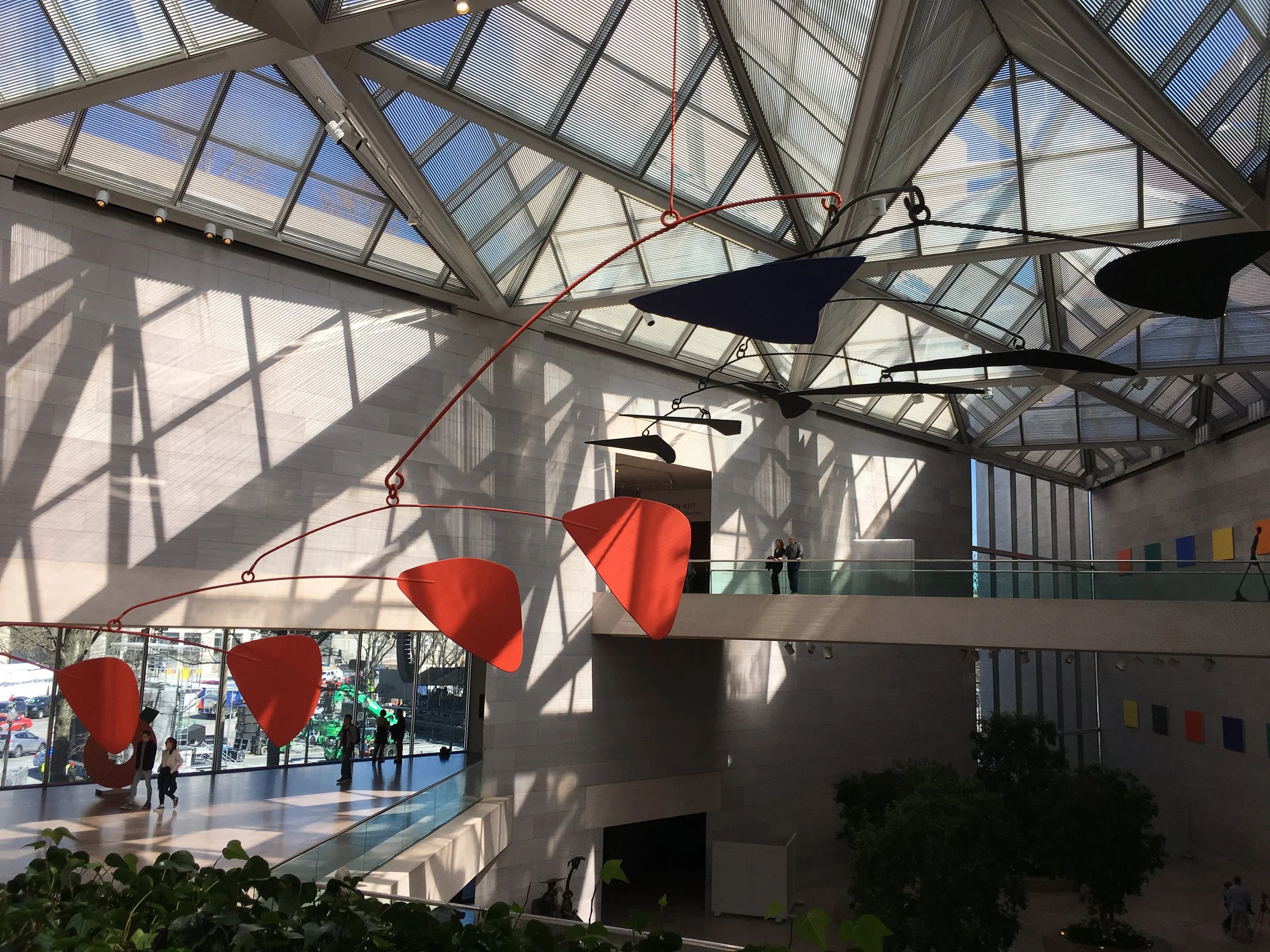
Alexander Calder, Untitled, 1976, aluminum and steel, Gift of the Collectors Committee, 1977.76.1.
I came of age in the ’80s when suddenly everything from education to healthcare to non-profits to government needed to be “run like a business.” This was supposed to bring along efficiency and fiscal responsibility. It made business the paragon of work outcomes without exploring the actual outcomes of the work, or the unintended consequences of efficiency or cost-cutting.
Businesses exist to make a profit — if they don’t, they can be shut down and sold for parts. But there are many services that exist not to make a profit, but to provide something bigger. Your town exists as a place to live and for your family to grow. The hospital exists for your health and safety. If you run these entities into the ground and sell them for parts, then you don’t have a place to live and you don’t have a place to go when you are sick.
Mission-driven leaders I coach often hold themselves to expectations of linear career trajectories and clear-cut outcomes, even though the environments they work in are in turmoil, and even though they have to keep serving their clients, regardless of turmoil. Mission-driven leaders need a different framework or model to understand their work. The business model is failing them and making their burnout worse.
Enter art. Recently, I had the good fortune to go to the new Calder Gardens museum in Philadelphia which showcases the work of the sculptor Alexander Calder and watch a documentary on Calder. I was reminded that mission-driven leadership is also creative leadership. Mission-driven leaders can look to art for guidance, not just to business.
Artists aren’t expected to be efficient — they are expected to hone their craft. They are expected to experiment, explore, and innovate. And no matter what artist you study, you can watch them explore their love and passion of something. Their work is never the same year to year, even though you can recognize elements. They constantly shift perspective — they let themselves be influenced by other artists and the environment. They are not concerned about getting it “right” — they are concerned that every single day they move their craft and art forward.
I work with leaders across many fields: physicians, journalists, public service, first responders, protectors of our national resources. They are people who know their “why” but are often thwarted by a system or by policies in the larger system. They often feel stuck or frustrated. And now many of them are managing loss and grief in the wake of budget and funding cuts.
As a mission-driven leader, you have much more freedom of movement than you think you do. In the way that Calder moved from drawing to painting, to sketching with wire to sculpting with tin cans to sculpting with steel, you have freedom of the way you sculpt your teams, your vision, your work.
Mission-driven leaders have the same gift as artists do: the ability to see what isn’t there and to bring it to life so others can experience it. Their materials are people and projects.
What if you paired people up during a particular stressor?
What if you brought your team together to brainstorm a particular issue?
What if you celebrated your mission weekly?
What if there was a spreadsheet of impact, not just budget?
The alignment of all workplaces as “business” kills creativity because creative solutions are rarely “efficient” solutions. “Efficiency” has most leaders thinking that under stress we need to cut things. Everything is approached with a mathematical view—and it ends in an experience of deprivation or a lack of resources. But the truth is it’s hard to problem-solve when you feel like there aren’t any resources.
What leaders actually need is both the permission and the reminder to add things in — or to look at the problem differently — to see the landscape differently. Right now, mission-driven leaders need a greater ability to meet the current problems with a wider range of creative solutions.
Artists have always had to survive difficulty. During World War 2, artists lost their supplies. Paul Klee famously used cloth diaper fabric to create his painting canvases when linen canvases were unavailable. And Alexander Calder couldn’t get aluminum for his sculptures, so he switched to carving in wood.
So many leaders are frustrated because they want to know what to do and where they are going, forgetting that creative leaders need to lean in to wonder instead of knowing. They need to create space for inquiry and exploration — places where you can create or build what is needed now.
Explore and Practice
Get a package of pipe cleaners and have your whole team make mini-sculptures of:
The greatest challenge facing your work.
The greatest strength of the team.
See if themes emerge—and if these themes can help you see your challenges and strengths in a new way.
Questions for Further Exploration
Calder’s sculptures lean into the idea of balance: heavy objects –delicately balanced.
What are some leadership challenges that you need to hold lightly?
What are you doing to support balance—in your life? For the team?
What about when the winds of life show up? (Here’s a video of Calder’s sculpture at the Louisiana Museum in Copenhagen managing the elements.)