
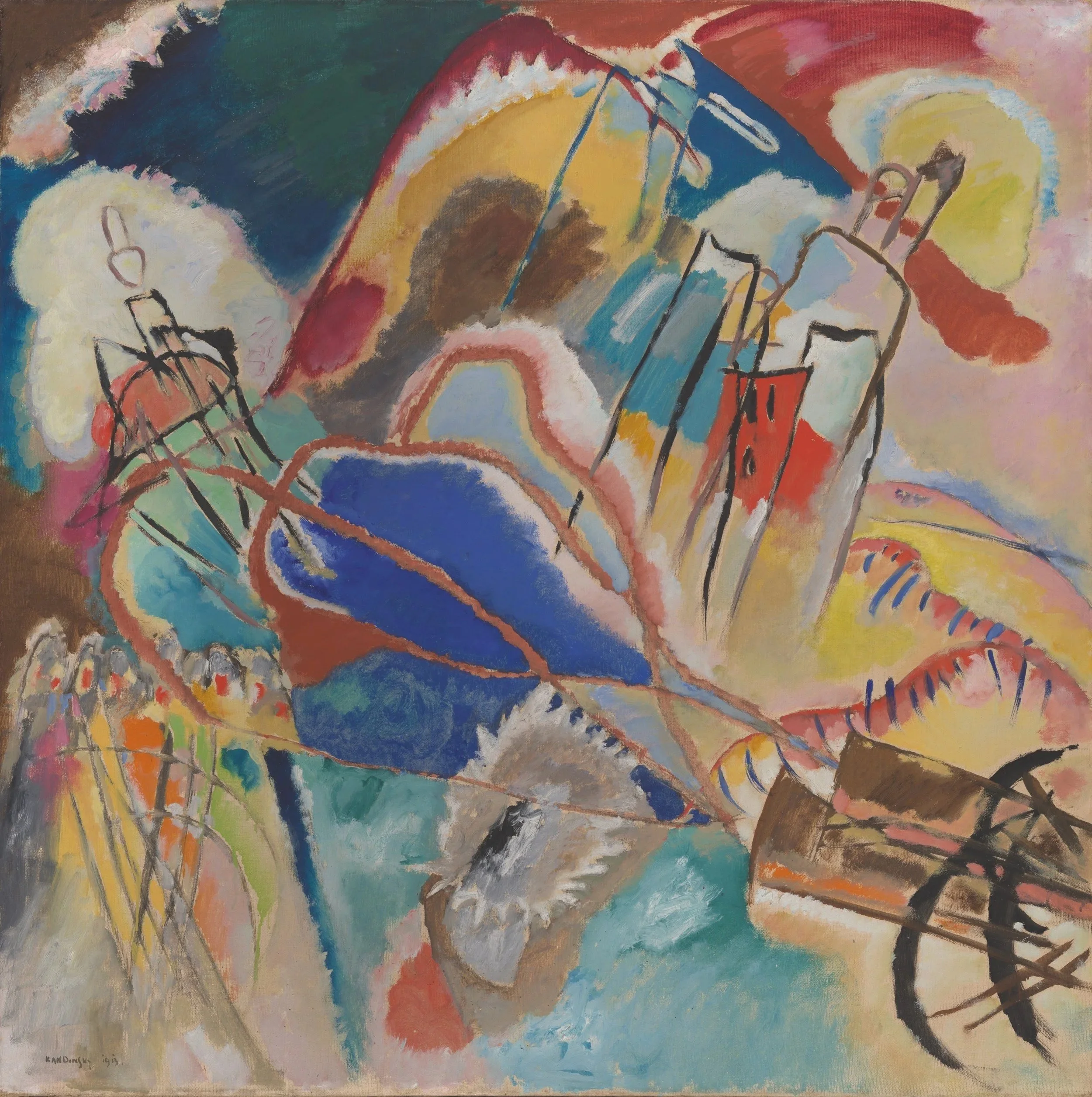
Vasily Kandinsky, Improvisation No. 30 (Cannons), 1913. Art Institute of Chicago.
I’ve been a consultant and coach for over twenty years and there has never been a time when I watched leaders wrestle with courage as much as they are now. Leadership is never easy, but now leaders are holding their teams through constant pressure, downsizing and layoffs, political polarization and retribution, and the trauma of shootings, ICE, and natural disasters. In mission-driven organizations, leaders are navigating the difficult terrain of their mission and values being attacked. Leaders are being called to lead through this complexity holding their own values, their teams’ well-being—and the work they are trying to get done—all at once. It’s no wonder they are wrestling with courage.
Dr. Maya Angelou said that “courage is the most important of virtues, because without courage, you cannot practice any other virtue consistently.” She valued courage for the strength to both stand up for yourself and stand up for somebody else—which may be the most solid definition of leadership we need for these times.
Almost every definition of courage requires you to hold two things at once. Author and psychologist Susan Jeffers described courage as the ability to “feel fear and do it anyway.” Courage requires us to hold one set of feelings and behave in a way that ignores those feelings: “grace under pressure” (Ernest Hemingway) and “triumph over fear” (Nelson Mandela). Brené Brown states that “you can’t choose both courage and comfort,” making the important point that doing good doesn’t necessarily feel good. Instead, we need to hold different (and often contrasting) emotions, our values, and aspirations—all at the same time.
In trainings and coaching sessions, clients often talk about feeling like they don’t have confidence. Or they get feedback that they need to be more confident. But confidence isn’t an input. It’s an outcome. Confidence is the outcome of practice and experience. Courage may be its opposite. I think most of us want to see courage as an outcome, or we imagine courage feeling the way it looks in the movies when the hero has overcome obstacles. But courage is an input. It is the stubborn and steadfast companion that gets us to practice hard things.
One of the skills or muscles that needs to be developed to have courage is the ability to hold two things at once. To hold fear and action. To hold hope and despair. To hold anger and compassion. The need for courage almost always shows up with the sentence: I want to _____ but I ____. “I want to stand up for my team, but I am afraid.”
We can all grow the capacity to hold two things, or even multiple things at once. And that’s where art can support us. Art asks us to see, to be present with many things at once. When we are looking at a painting or a sculpture, we stop to take it in. When we watch a play or opera, we constantly shift attention to take in what we are observing. When we listen to music, we listen to the melody, the voice, and the lyrics.
But we do even more than that. Because art is always a relationship. “We never look at just one thing: we are always looking at the relations between things and ourselves,” writes author and painter John Berger in Ways of Seeing. Art helps us practice holding two things at the same time: what are looking at and our experience of what we are looking at. We can hold what we imagine the artist was trying to express or depict, and we can hold what we are experiencing as we look or listen. We can practice holding both experiences at the same time without the need to judge or find an absolute right. It’s especially vivid when you stand in front of a painting or listen to a song with someone else: the art object is there, but neither of us see or hear exactly the same thing.
But perhaps courage doesn’t just require us to hold two emotions, but rather two versions of ourselves—the person we wish we could be, and the actual person we are. The way we wish we could respond and the way we are currently capable of responding. We want to do the right thing and say the right thing, and we have to hold that we are human, and will inevitably get it wrong sometimes. This is a lesson that poet Adrienne Rich so artfully explores in her poem Integrity:
Anger and tenderness: my selves.
And now I can believe they breathe in me
as angels, not polarities.
Anger and tenderness: the spider’s genius
to spin and weave in the same action
from her own body, anywhere —
even from a broken web.
Sources:
https://news.cornell.edu/stories/2008/05/courage-most-important-virtue-maya-angelou-tells-seniors
Brown, Brené. (2012) Daring Greatly: How the Courage to Be Vulnerable Transforms the Way We Live, Love, Parent and Lead. Penguin Random House, New York.
Berger, John. (2008). Ways of Seeing. Penguin Books, p. 8.
Rich, Adrienne. (1981, 4 1). Integrity. The Iowa Review, 12(2-3), 293–294.